
The South Houston Tax Blueprint: Decoding MUDs, PIDs, and Property Taxes in 2026
If you’ve been browsing homes in Pearland, Friendswood, or League City, you may have noticed that two homes with the same price tag can have vastly different monthly mortgage payments. In Texas, the "sticker price" is only half the story. The other half is written in three-letter acronyms: MUD and PID.
As an advisor who has helped families navigate these waters for over 20 years, I know that understanding your total tax burden is the key to a stress-free purchase. Let’s break down the 2026 tax landscape so you can buy with confidence.
1. The Core: Standard Property Taxes
In Texas, we have no state income tax, which means our local infrastructure, schools, and emergency services are funded primarily through property taxes. Your bill is a "layer cake" of different taxing entities.
The 2026 Snapshot:
-
School Districts (ISD): Usually the largest slice of the pie. For the 2025–26 tax year, Friendswood ISD is operating at a total rate of $1.03 per $100 valuation — actually a slight decrease from the prior year as the district continues its track record of responsible fiscal management. Pearland ISD is holding steady at $1.135 per $100 valuation, unchanged from the previous year.
-
City & County: Cities like League City have worked to keep rates lean, with a 2025–26 adopted rate of $0.36355 — marking the 11th consecutive year the city's property tax rate has decreased. That kind of sustained commitment to keeping costs in check is worth noting if you're comparing communities across the Houston metro.
-
Special Districts: This is where things get interesting.

2. The MUD: Municipal Utility Districts
What Is a MUD? A MUD — Municipal Utility District — is a special political subdivision created under Texas law to provide water, sewer, and drainage infrastructure in areas where city services don't yet exist. They're especially common in the newer master-planned communities throughout Southeast Houston.
-
How It Works: Rather than waiting for a city to expand services into a developing area, a developer funds the infrastructure upfront. The MUD then issues bonds to reimburse the developer for those costs. Homeowners within the district pay a MUD tax — based on their home's assessed value — to repay that bond debt over time, along with ongoing maintenance costs. Only the residents inside the MUD pay for it; the general public does not.
-
The Good News About MUD Taxes: Because the tax is tied to paying off a fixed debt, rates typically decrease as the bonds are paid down and more homes are built within the district to share the cost. In some cases, once the debt is fully retired, the MUD tax can drop to little or nothing.
-
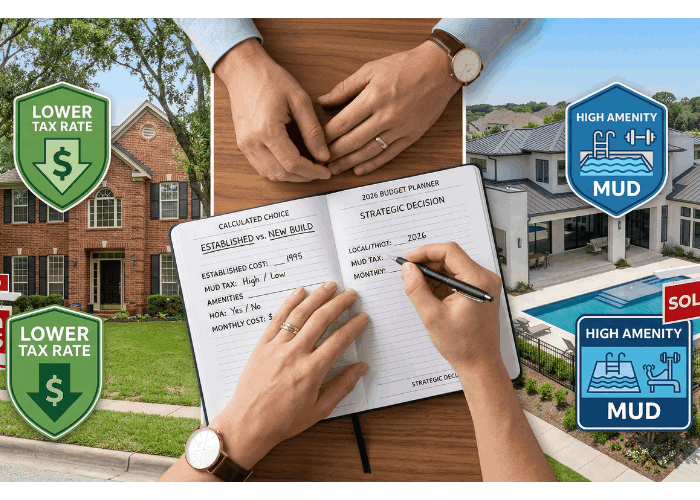
Strategic Tip for Buyers: In established areas of Pearland or League City, many MUDs have significantly paid down — or fully retired — their bond debt, resulting in a much lower total tax rate compared to brand-new developments. When you're comparing two homes at similar price points, it's worth looking beyond the listing and asking: what's the MUD rate? That number can meaningfully impact your monthly payment.

3. The PID: Public Improvement Districts
What Is a PID? A PID — Public Improvement District — is a defined geographic area where a city or county levies a special assessment to fund enhancements that go beyond basic utilities. Think of it as a financing tool that allows a developer to deliver a higher-end community without building all of those costs into the purchase price upfront.
-
What It Funds: PIDs typically cover enhanced landscaping and irrigation, entry monuments, pedestrian trails, community parks, and open space amenities — the finishing touches that give master-planned communities their polished look and feel.
-
The Payment Structure: Unlike a MUD tax, which is based on your home's assessed value, a PID assessment is generally a fixed amount tied to your lot size. It shows up on your property tax bill annually, but it is not a property tax — it's a lien against your specific property. Homestead exemptions do not apply.
-
The "Exit" Strategy: One major advantage of a PID over a MUD is that the assessment can be paid off in full at any time. Once paid, the lien is permanently released and that line item disappears from your tax bill. Many sellers are using "PID Paid in Full" as a meaningful marketing highlight to attract buyers focused on keeping monthly costs lean — and it works, because it genuinely lowers the ongoing payment obligation from day one.
4. Side-by-Side: MUD vs. PID in 2026
| Feature | Municipal Utility District (MUD) | Public Improvement District (PID) |
| Primary Purpose | Essential Utilities (Water/Sewer) | Community Enhancements (Parks/Trails) |
| Payment Type | Property Tax (Based on Home Value) | Special Assessment (Often Fixed Amount) |
| Duration | Lasts until debt is retired or annexed | Lasts until assessment is paid in full |
| Governance | Independent Elected Board | City or County Oversight |
| Can you pay it off? | No,it’s a recurring tax | Yes,can often be paid as a lump sum |
Why This Matters for Your 2026 Budget
How Taxes Directly Affect What You Can Buy
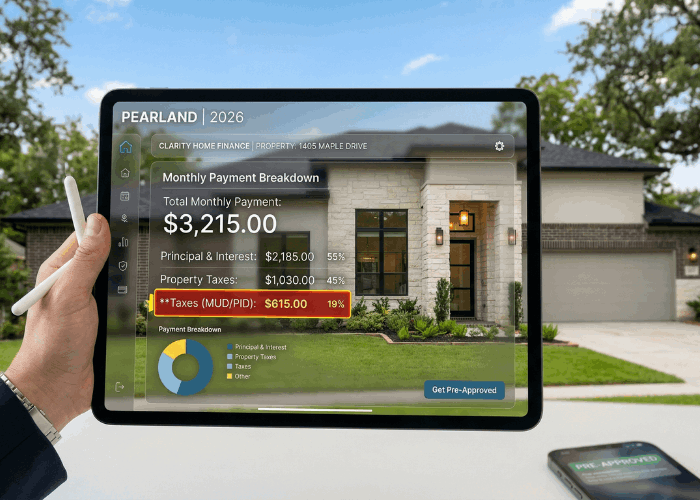
When a lender qualifies you for a loan, they calculate your PITI — Principal, Interest, Taxes, and Insurance. A high MUD tax or active PID assessment gets factored directly into that equation, which means it reduces your buying power whether you realize it or not.
Here's what that looks like in real numbers (based on estimated rates; actual tax bills will vary based on exemptions, district, and appraised value):
- Home A: $500,000 purchase price + ~2.1% effective tax rate (established area, no active MUD/PID) = approximately $875/month in taxes
- Home B: $500,000 purchase price + ~3.4% effective tax rate (new construction with active MUD and PID) = approximately $1,417/month in taxes
That $542 monthly difference adds up to more than $6,500 per year — the equivalent of a car payment, a family vacation, or a meaningful head start on your emergency fund.
Two homes. Same price. Very different financial realities.
This is exactly why knowing the full tax picture before you fall in love with a kitchen matters. As your buyer's agent, I pull the complete tax breakdown on every home we consider — not just the listing price — so you can make a truly informed decision.
The Verdict: Don't Fear the Acronyms
MUDs and PIDs make possible some of the most beautifully designed, high-amenity neighborhoods in the Houston area. They aren't something to fear — they just require the right strategy and a clear-eyed look at the full picture before you commit.
That's exactly what I do for every buyer I work with. I run a complete Total Cost of Ownership analysis on every home we consider — breaking down the ISD rate, city and county taxes, MUD obligations, PID assessments, HOA dues, and insurance estimates — so you know your real monthly number before you ever make an offer. No guesswork. No sticker shock when your first mortgage statement arrives.
Because the right home isn't just the one with the kitchen you love. It's the one you can comfortably afford to live in for years to come.
Contact Shelley Broussard Today:
-
Call or Text: 832-890-3504
LEGAL DISCLAIMER
Fair Housing: Shelley Broussard and Real Broker, LLC provide equal professional service regardless of race, color, religion, sex, disability, familial status, or national origin.
Accuracy: All tax rate data referenced in this post — including the League City adopted rate of $0.36355, Friendswood ISD at $1.03, and Pearland ISD at $1.135 — reflects 2025–2026 adopted rates per $100 of assessed valuation. Tax rates are set annually by local taxing authorities and are subject to change. MUD tax rates and PID assessments vary by individual district and parcel and are not reflected in the rates above. Always verify the complete tax picture for any specific property with the appropriate appraisal district: Brazoria Central Appraisal District (BCAD), Galveston Central Appraisal District (GCAD), or Harris Central Appraisal District (HCAD), depending on the county in which the property is located.
Educational Purpose: This content is intended for general informational and educational purposes only and does not constitute financial, tax, or legal advice. Consult a qualified professional for guidance specific to your situation.
Categories
- All Blogs (98)
- Builder (2)
- Buyer (34)
- Closing Costs (10)
- First Time Home Buyer (13)
- Friendswood Neighborhoods (20)
- Houston Neighborhoods (19)
- Incentives (8)
- Just Fun (2)
- League City Neighborhoods (20)
- Manvel Neighborhoods (20)
- New Construction (3)
- New Homes (6)
- Pearland Neighborhoods (15)
- Real Estate (34)
- Real Estate Agent (18)
- Realtor (11)
- Relocation (16)
- Seller (33)
Recent Posts